Views: 0 Author: Shunhong Electrical Appliance Co., Ltd. Publish Time: 2026-11-17 Origin: Shunhong transformer


For most people moving from North America to Europe, the coffee maker is the first appliance they reach for in the morning and the first one that fails. A US drip machine or single-serve brewer is single-voltage 120V — plug it into a 230V European socket through a travel adapter and the heating element burns out in one cycle. The fix is a 220V to 110V step-down converter, and coffee makers sit in an awkward middle zone: too powerful for the small converters sold for laptops, well below the hair dryer class.
This page gives the exact sizes for drip, single-serve and espresso machines — and the combined-kitchen math that most guides skip.
A standard 12-cup drip coffee maker (800–1100W) needs a 2000VA step-down converter. Single-serve brewers and espresso machines (1400–1600W) need 3000VA. Almost no coffee maker has a dual-voltage switch, so unlike hair dryers, there is no shortcut — if it is a US model, it needs the converter.
A coffee maker looks small, but brewing is a pure heating job: the machine pulls full rated power for the entire brew cycle, every morning, forever. Read the label on the base or in the manual — typical US ratings:
Coffee maker type | Typical US rating | Minimum converter size |
4–5 cup compact drip | 550–700W | 1500VA |
10–12 cup family drip | 800–1100W | 2000VA |
Single-serve pod brewer | 1400–1500W | 3000VA |
Entry espresso machine | 800–1000W | 2000VA |
Espresso + built-in grinder | 1300–1600W | 3000VA |
Two notes on reading the label: if the nameplate shows amps (A) instead of watts, multiply by 120 (a 120V 9A machine is 1080W). If the machine has a built-in grinder, size by the total rating — the grinder motor stacks on top of the heating cycle.
Using US Appliances in Europe: 220V to 110V Transformer Guide
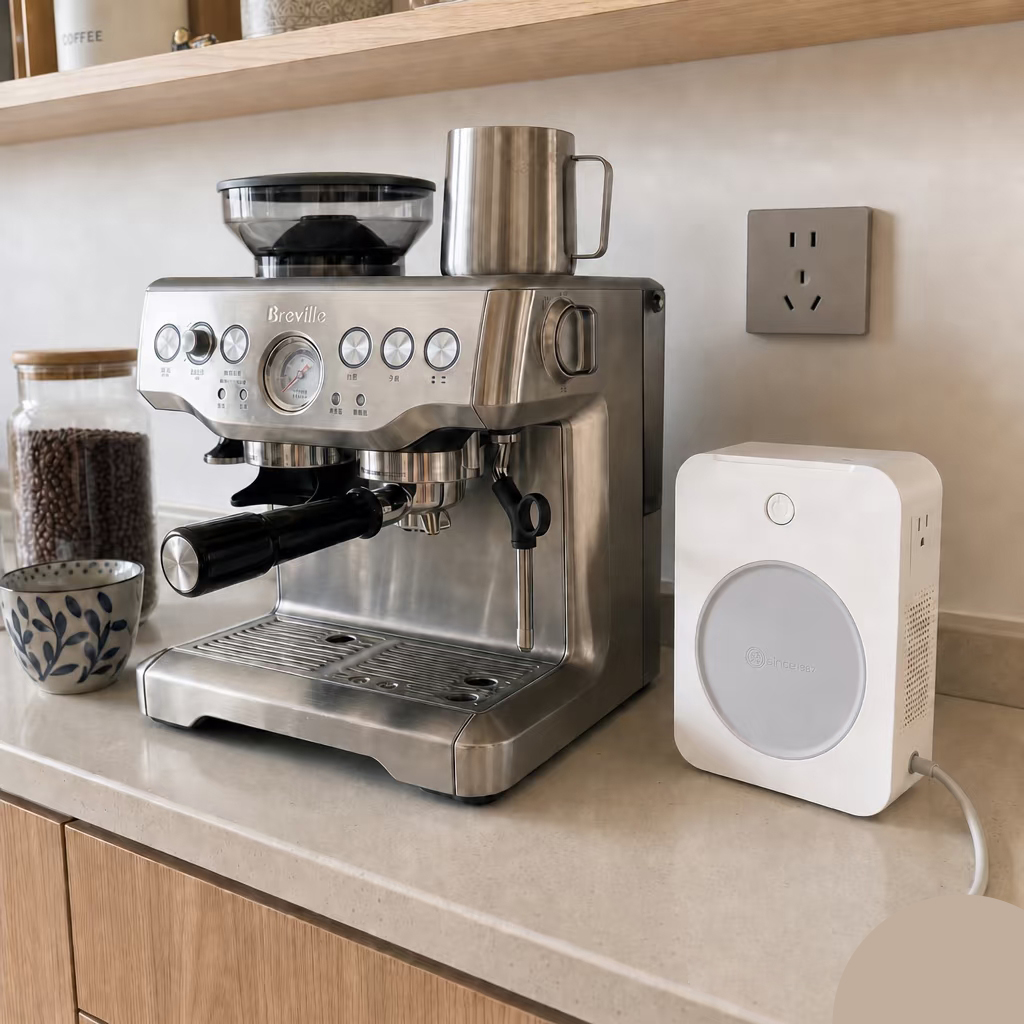
The sizing rule is the same ×1.5 heating multiplier used across every resistive appliance, followed by the power factor correction:
Example 1 — a 900W family drip machine:
900W × 1.5 = 1350W
1350W ÷ 0.75 (power factor) = 1800VA → 2000VA unit
Example 2 — a 1450W single-serve brewer:
1450W × 1.5 = 2175W
2175W ÷ 0.75 = 2900VA → 3000VA unit
An undersized converter trips its thermal protection halfway through a brew or sags the voltage enough to stretch the cycle badly. Oversizing costs nothing except weight — a bigger unit runs cooler and lasts longer.
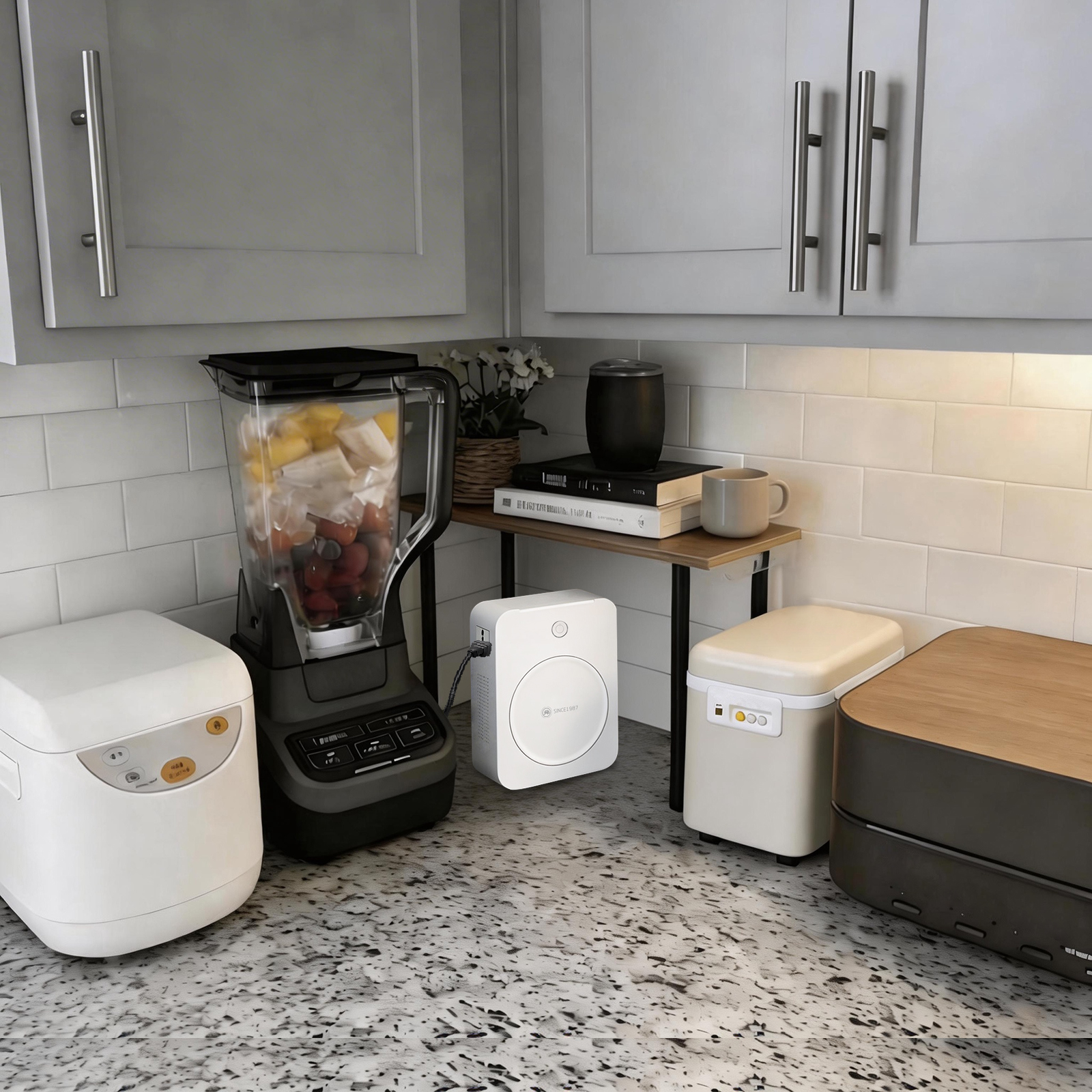
The first thing we tell hair dryer owners is to check for a 125/250V switch, because many dryers have one and it saves the whole purchase. Coffee makers almost never have one.
Drip machines, pod brewers and consumer espresso machines are single-voltage 120V products for the US market — no switch, no 100–240V marking. There are rare exceptions (a few travel-sized drip models), so look at the base label before ordering; if it says 120V or 110–120V only, you need the converter.
Yes, cleanly. A drip machine is a heating element plus a thermostat — neither cares about frequency. Digital brew-later timers keep their own time. Even espresso machines with vibration pumps and combo units with grinder motors use motor types that tolerate both 50Hz and 60Hz.
The converter fixes the voltage; frequency is a property of the European grid and is not a problem in this category. That makes coffee makers one of the safest appliances to run through a transformer — the whole risk is sizing, not frequency.
Here is where coffee makers differ from hair dryers: a kitchen converter almost never serves just one appliance. The realistic morning is coffee maker and rice cooker, or coffee maker and toaster, on the same counter. Size for the sum of everything that could ever run together.
Worked example — a shared kitchen counter:
900W coffee maker + 650W rice cooker = 1550W
1550W × 1.5 = 2325W
2325W ÷ 0.75 = 3100VA → 5000VA unit (3000VA is too tight)
Add a kettle or blender to that mix and you are past 5000VA. This is why our rice cooker converter guide recommends splitting the house: one dedicated converter per high-power appliance is usually cheaper and cooler-running than one giant shared unit — but if your kitchen genuinely runs two appliances at once every morning, size the shared unit honestly at 5000VA.
The same four checks as any heating appliance:
1. Input range covers 220–240V. European mains is 230V nominal; the UK often measures closer to 240V. Confirm the converter nameplate states 220–240V input, not just "220V".
2. Continuous rating, not peak. A brew cycle is 5–10 minutes of full draw, repeated daily. The figure that matters is the continuous VA rating — compact "universal converters" that quote 3000W as a momentary peak cannot sustain it.
3. Output socket is US-style. Your coffee maker has a NEMA 5-15 plug. Confirm a US three-prong grounded output so the machine plugs in exactly as it does at home — an output adapter on a circuit carrying real current is a contact point and failure point you do not need.
4. Input plug matches the country. Germany Type F (Schuko), France Type E, Italy Type L, UK Type G, Switzerland Type J. Get the plug fitted at the factory; a travel plug adapter is not rated for 10A+ continuous transformer input.
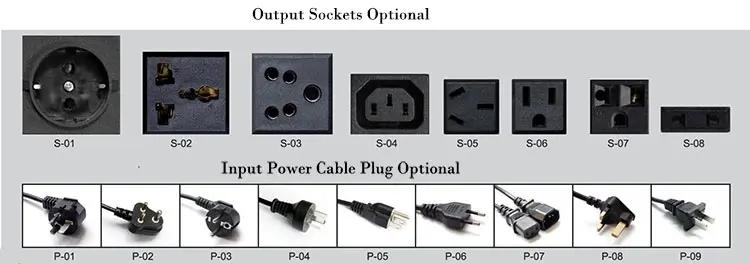
Within the Shunhong range, the pairings that fit coffee makers:
TG20001 (2000VA, pure copper) or G20001 (2000VA, aluminium) — the standard choice for a 10–12 cup drip machine or entry espresso unit. Pure copper runs cooler under the daily morning duty cycle.
TG30001 (3000VA, pure copper) — for single-serve brewers, espresso machines with grinders, or a shared counter that stays under 2000W combined.
TG50001 (5000VA) — the honest choice if coffee maker, rice cooker and anything else share one unit every morning.
If the same converter will also serve audio or medical gear, step up to the TGL isolating series, which adds a galvanic isolation barrier between mains and output — a coffee maker does not need it, but it costs nothing to future-proof the placement.
What size converter do I need for a 12-cup coffee maker?
A 10–12 cup drip machine draws 800–1100W. At the ×1.5 heating multiplier and a 0.75 power factor, that lands at 2000VA. A compact 4–5 cup model fits a 1500VA unit.
Can I run a Keurig or single-serve brewer in Europe?
Yes, through a step-down converter sized at 3000VA — single-serve brewers draw 1400–1500W, and the ×1.5 margin puts them just under 3000VA. Do not use a plug adapter alone; the machine is single-voltage 120V and 230V will destroy the heating element.
Can one converter run a coffee maker and a rice cooker together?
Only if sized for the sum: 900W + 650W = 1550W, ×1.5 ÷ 0.75 ≈ 3100VA — take a 5000VA unit. For most kitchens, two smaller dedicated converters (2000VA each) cost less and run cooler than one 5000VA shared unit.
Do espresso machines need a special converter?
No special type — the pump's brief start surge is well inside the ×1.5 heating margin. Size by the total nameplate watts: entry machines (800–1000W) fit 2000VA, grinder-combo and prosumer machines (1300–1600W) need 3000VA.
Will a coffee maker work on 50Hz in Europe?
Yes. Heating elements and thermostats are frequency-blind, digital timers keep their own clock, and the small pump and grinder motors tolerate both 50Hz and 60Hz. Frequency is not a risk in this category.
Do coffee makers come with dual voltage like hair dryers?
Almost never. US-market coffee makers are single-voltage 120V products without a 125/250V switch — unlike travel hair dryers, where the switch is common. Check the base label, but plan on needing the converter.
Send us a photo of your coffee maker's nameplate and the country you are moving to, and we will confirm the converter size and input plug — free, before you order.
WhatsApp: +86 136 9069 8363 — fastest for a nameplate photo
Enquiry form: 【contact us】
[Shunhong] has manufactured voltage converters in Foshan since 1987 — 39 years, more than 10,000,000 units, CE / FCC / RoHS / CQC certified across the full 60VA–16000VA range, three-year warranty.